
Find Your Tribe
8/25/20253 min read
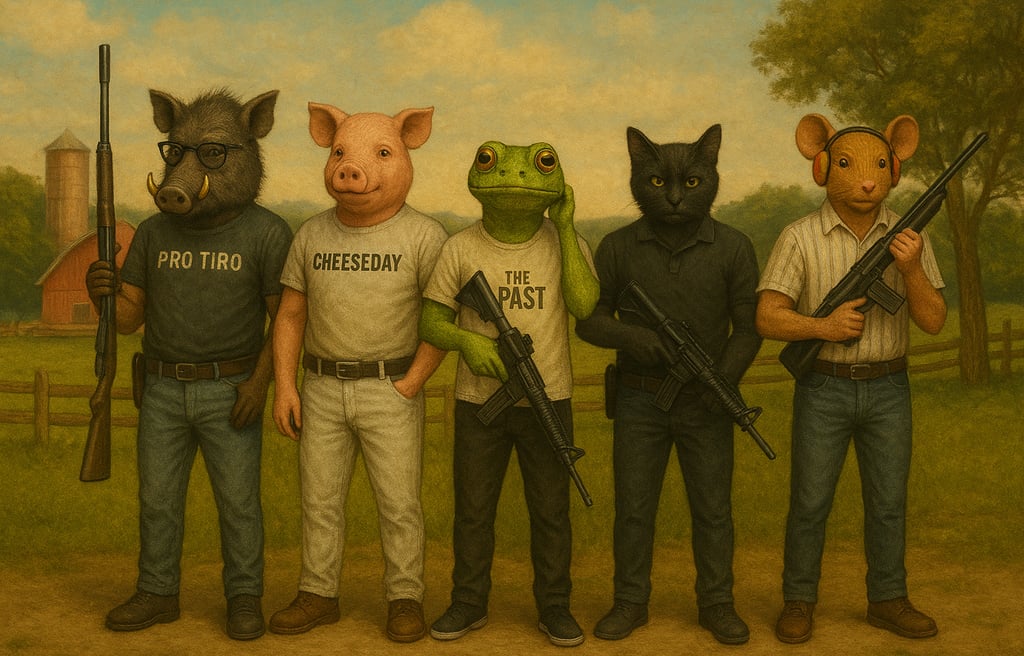
Imagine a world in collapse: natural disasters, unexpected accidents, political, financial, and social crises. Or consider your own personal world falling apart: you go camping and the vehicle simply won’t start, or you buy a new scope and need to zero your rifle, but don’t know where to begin. Whether facing large-scale disasters or small unforeseen challenges, when chaos knocks at your door, will you be ready? Will you try to face everything alone, under the illusion of being a lone hero, or will you protect your family, support your friends, and build a plan together? And more importantly: are you sure those you trust are also prepared, or do you just assume they’ll be there when you need them most?
One of the least understood aspects of “preparation” and “survival” is that it isn’t just about techniques, tools, or equipment. The real foundation lies in building a network and fostering a sense of community - the ability to think not only of your own interests but also of the well-being of the group around you.
When asked, “if it does matter who would be in the trenches by your side” Ernest Hemingway answered: “more than the war itself.” This statement reveals something essential: as appealing as the image of the “lone wolf” surviving in a post-apocalyptic world may be, the truth is that humans are social creatures. Life in a group was not a minor detail in our evolution, it was a fundamental condition for survival.
The word “tribe” comes from the Latin tribus and, according to the Oxford Dictionary, is defined as “an autonomous social group exhibiting some degree of homogeneity (physical, linguistic, cultural).” It is precisely this homogeneity that we lack today, this absence of belonging that makes us feel like “fish out of water.” In a society fragmented by deep ethical and moral disputes, it is not only legitimate to question the world we live in - it is the duty of those who seek justice.
Anthropology provides a key to understanding this loss of cohesion: Dunbar’s Number. Robin Dunbar demonstrated that the human mind can maintain only a limited number of meaningful relationships, on average, about 150 people. Within this circle, there are even closer layers: five intimate bonds, fifteen deep-trust relationships, fifty regular interactions. Beyond that, cohesion dissolves, and we must rely on institutions, laws, and systems to replace the natural trust that once existed. That is why, in times of crisis, it is not the city or the state that ensures our survival, but the circle of people we call our tribe. Finding this group - whether it consists of family, friends, training partners, or trusted neighbours - is a way to reclaim a lost dimension of our humanity.
But how do you build such a tribe? The answer is to combine utility with enjoyment: lift weights at the gym, practice self-defense or martial arts, go to the shooting range, join a hunting association, volunteer with the local Police Department or Search-and-Rescue groups, participate in your church. These are environments where you will meet people with the same purpose - and, more importantly, with skills and experience that could be crucial in a crisis, all while contributing to the community.
Gathering with friends is always mutually beneficial. Who hasn’t participated in a training session or competition just to have the company of someone they know? And likewise, how many times have we skipped an event because we didn’t know anyone? When you find your tribe, be an example. Do not tolerate bad character, lies, or ideas that deviate from what is right. Remember: an armed citizen should be polished, honest, and true - not a boastful show-off.
History shows that our true strength has always been in numbers, not isolation. Building a support network with friends and family allows you to compensate for weaknesses, reduce vulnerabilities, and increase your chances of success. Discuss techniques, share tactics, exchange equipment and ideas… train together! By growing alongside your group, you strengthen yourself and make preparation not only more effective but also more enjoyable.
But all of this takes time. Don’t postpone the inevitable. Start now: find your tribe.
Did you find this article helpful? Let us know, your feedback helps us improve and bring you more relevant content. Send your thoughts to contact@junosolutions.ca