Practical vs Tactical Shooter
8/31/20255 min read
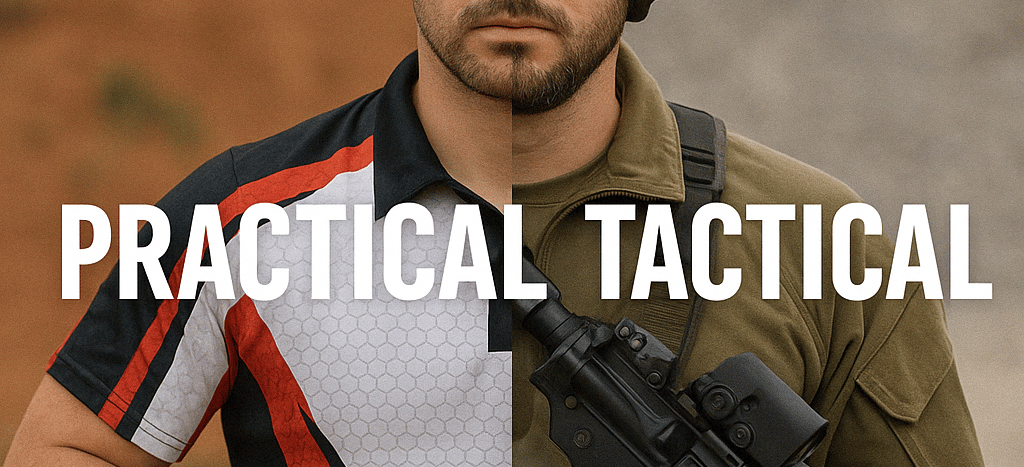
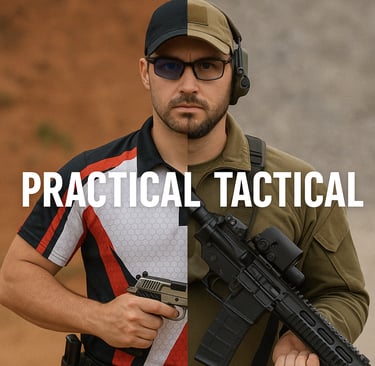
Stop and think: is the street really the only place where your shooting skills are truly tested? If not, then how could you measure your abilities - and could that test happen while you remain anonymous and safe at the shooting range?
At some point, you may face an unknown adversary in a lethal-force encounter. The question is simple: how well do you think you would perform against someone who is genuinely skilled and trains regularly? Have you ever wondered how your firearm skills compare to your teammates or to officers across your department - or even to all pistol shooters in your state? After all, how do you truly know how good you are?
For years, public safety officers, military personnel, and even shooting instructors have avoided competition, repeating the mantra: “competition will kill you.” Many believe their shooting technique surpasses that of sport shooters, and that in a real-life life-or-death situation, they would be fast and accurate under pressure - after all, they consider themselves “more tactical.”
The author was once part of this mindset. He would train alone - dry-fire at home or at the range - averaging his times and hits in a given exercise, and taking that as his benchmark for success. This is what American police officer and sport shooter Ron Avery (who inspired this article) calls “presumed skill”: the ability developed at the range without meaningful pressure, where failure has no consequences. Presumed skill is merely an indicator of potential performance, not a true measure of real-world capability.
Sport shooting gained wider attention after reading accounts from former U.S. Army elite operators - Delta Force members like Kyle Lamb, Mike Panonne and Matt Pranka - who described learning to shoot with multi-time champion Rob Leatham. Recently USPSA champion Ben Stoeger was training the Canadian Special Operations Regiment. How could the top tactical experts invite a civilian to teach them to shoot?
What is competition?
In essence, competition is when two or more people vie for something limited - a prize or recognition that both want. Competitions date back to prehistoric times, when groups competed in hunting and gathering to survive. Overcoming physical and mental challenges was essential, and competition developed naturally as a way to demonstrate skill, strength, and intelligence.
In shooting, the first competitions appeared in the late 19th century. Today, the most popular discipline is IPSC (International Practical Shooting Confederation), created by Marine Colonel Jeff Cooper to develop a sport shooting format that was realistic and practical. Cooper believed that the shooting sports of his time didn’t prepare people for the skills needed for real-world self-defense - the same discussion we’re having now, fifty years later.
Why don’t we compete?
Some officers and instructors avoid competition entirely. Common reasons include:
Lack of tactics: To be fair, a sport must give all competitors equal opportunities. IPSC follows the principle “shoot where you can see”, often minimizing cover to maximize engagement speed. Critics argue this doesn’t prepare shooters for real-life street scenarios.
Unrealistic equipment: Sport shooting gear often differs from what police and military personnel use in the field. Highly modified firearms, triggers, and sights may create habits that don’t translate to tactical work.
Sport shooting isn’t tactical training: In competition, you won’t methodically “slice the pie” like in CQB exercises. Timers are running, fractions of seconds matter, there’s no verbal de-escalation, and there’s usually no need to fire more than twice at a paper target. This can lead to bad habits.
Ego: Nobody likes to lose. But growth comes through adversity. Beginners must go through the “phase of the ridiculous.” Experienced officers may refuse to accept that their shooting isn’t as good as they thought, resisting a realistic self-assessment.
High cost: Sport shooting isn’t cheap - gear, firearms, ammo, and time all carry significant costs. Often, it’s a matter of priorities: what matters more - a new car, flashy jewelry, the latest phone, or your training? Additionally, many shooting clubs and businesses donate ammunition for public safety officer training - so excuses don’t hold.
Why should you compete?
Competition teaches control - over your emotions, your body, and your weapon. Most importantly, it tests your ability to perform under pressure.
Developing the will to win: If you knew exactly when you’d face a lethal confrontation, you’d train like an Olympic athlete. Competition provides that structure, helping you establish a routine and maintain readiness for real-life encounters - unlike the “just pass the test” mentality many officers adopt.
Strengthening character: Numbers don’t lie. Timers and scores reveal your true condition. Who can look in the mirror and accept reality? Only the strong of character. Others choose lies, excuses, and dishonor.
Superior weapon handling and stress shooting: Competitive shooters operate at a higher proficiency level. Adapting their skills to tactical contexts is far easier than trying to raise a mediocre shooter to the same level.
Situational awareness and multitasking: Competitive shooting develops multitasking: moving, tracking targets, reloading, troubleshooting malfunctions, and maintaining safety. Regular competition makes these skills almost automatic, improving decision-making and reaction speed under stress.
Safe handling: IPSC likely has the best safety record in any sport. More participants mean fewer safety violations and accidents. Experienced shooters rarely need reminders about rules, even in tactical exercises.
Stress management: Competing under ego-driven pressure teaches calmness and focus. Ron Avery noted that national and international competitions were more stressful than real-life lethal encounters. Mike Panonne adds that knowing the date of a competition months in advance can create stress levels rivaling spontaneous deadly encounters - the body reacts to the mind’s perception of stress.
Learning and testing techniques and equipment: Jeff Cooper described IPSC as a testing ground for techniques and equipment. Many police accessories - holsters, mag carriers, magwells, red dots, compensators - originated in competition.
Will competition kill you?
Maybe. Will sitting on the couch between mandatory police qualifications kill you? Maybe. We know many officers and soldiers survive despite poor shooting and minimal training. But if you’ve read this far, you probably don’t want to rely on luck.
Before entering competition, ask yourself: why are you competing? To win at all costs, improve firearm handling, increase performance under pressure, have fun, learn new techniques, or test ideas? What will you do if you don’t perform as expected? Make excuses? Blame equipment? Claim you’d do better in a real situation?
Would competitive shooters outperform non-competitors in a tactical scenario? Absolutely, in shooting. In real-life situations, results are less predictable - but no one doubts a Formula 1 driver would outperform an average person in a street race, or an MMA fighter would beat a casual opponent. Sport shooters combine speed, accuracy, weapon safety, and decision-making - skills that translate directly to tactical advantage.
Don’t ignore the flaws of competitive shooting, but take what’s useful. Believing you’re the best without proof is complacency. Approach competition as an opportunity to learn about yourself, improve under pressure, and embrace its positive aspects. As the saying goes: “If it takes you to the mountain top, keep climbing.”
Competition doesn’t have to be formal. It can be as simple as two colleagues racing to draw. But once you dominate the small pond, it’s time to seek bigger waters.
If you want to become a better professional under fire, competition will help. If you want to know how good you are, you need to compete. If you want to be the best you can be, competition will get you there faster and more reliably than anything else. Testing yourself must happen before entering a gunfight, and there’s no better way to learn stress management than competing.
Competition is a way to test yourself and extract lessons to improve for next time. Don’t try to bend competition to your will - take what’s useful. If you can’t handle it, don’t participate and ruin someone else’s day. Be honest: if you truly believe backyard training equals competition under pressure, there’s no remedy.
Every training method has pros and cons. Force-on-Force also teaches bad habits, like hiding behind barriers that wouldn’t stop a real bullet. Complete training programs teach within the limits of the environment and equipment, providing context. As perspective grows, training becomes more valuable. Think of competition as part of developing critical skills - not a substitute for tactical training.
Did you find this article helpful? Let us know, your feedback helps us improve and bring you more relevant content. Send your thoughts to contact@junosolutions.ca