The Deadly Fight for the Gun
8/31/20256 min read
“I always trained both shooting and fighting, but criticism came from both sides. At the shooting range, I would hear: ‘If you know how to shoot, why would you need to fight?’ On the mat, the provocation was the opposite: ‘If you know how to fight, why would you need a gun?’ Both sides were wrong. As the saying goes: ‘To the man with only a hammer, every problem looks like a nail.’ Without the right tool for each situation, every solution will be limited.
The truth is, the intersection of armed and unarmed combat has always fascinated me because, in the real world, the two skills don’t compete with each other - they complement one another.”
According to the FBI’s LEOKA report, 68% of police officers killed in confrontations were shot at a distance of less than three meters. Even more alarming, 25% of them were killed with their own weapon. These numbers make one thing very clear: real combat rarely happens at long range. Instead, it happens face-to-face, where reaction time is minimal, and weapon control becomes a brutal physical struggle.
The Reality of Close-Range Combat
Many people mistakenly imagine an armed confrontation as two individuals separated by some distance, hiding behind barricades, exchanging fire. But think about a robbery attempt, a kidnapping, or a home invasion. In all these cases, the criminal is usually just a few meters away from the victim - sometimes even within arm’s reach. In reality, armed confrontations often occur at close range, which drastically changes the dynamics of the fight.
Close-range armed confrontations, also called Extreme Close Quarter Battle (ECQB) or Close Range Gun Fighting, are not ideal for someone carrying a firearm. The goal of any fighter should be to avoid that proximity, since distance favors the skilled shooter. However, in real-life situations, you don’t get to choose the distance or the timing. Combat can erupt at any moment, under any circumstance, which is why preparation for these scenarios is essential.
If we reduced an armed confrontation to an equation, two variables would weigh heavily in determining the outcome: distance and reaction time. One is intrinsically connected to the other. In short, the closer the aggressor, the less reaction time you have - a concept perfectly illustrated by Col. John Boyd’s OODA loop. The closer the threat, the less time you have to decide: whether to draw your weapon, control theirs, or adopt a defensive position. The ability to create or maintain distance can mean the difference between life and death.
You may recall the classic Tueller Drill, which demonstrates that an attacker can cover roughly 7 meters (21 feet) in the time it takes you to draw and fire your weapon. That’s an average, and it varies depending on the defender’s skill and movement. Now imagine that attacker already within your arm’s reach (less than 1 yard), while your weapon is still holstered, and he may or may not be armed.
If you focus only on options with your firearm, you basically have two: draw and attempt to fire immediately, or retreat while drawing to create space.
And this is where a serious problem arises: the aggressor isn’t a static paper target [see article on Force-on-Force]. He will fight for his life, possibly striking you and trying to take your weapon. If he is also armed and has already started his own draw, the most likely result is mutual destruction. At arm’s length, attempting to draw your weapon may be extremely risky. You could be struck before reaching it, or worse, end up in a direct struggle for control of it. That is the nightmare of every armed individual, because the consequences are unpredictable.
So how do you avoid being knocked out or losing your weapon to your enemy? How do you survive the fight for your life?
The Fight for Survival
If someone tries to take your weapon to kill you, there is no room for hesitation. If you are not willing to do anything - absolutely anything - to stop them, then you are not truly committed to winning.
Honor is a virtue with family, friends, and at work. But this is not an honorable game. If you lose your gun to a criminal, you will never see your family again. Understand this: in real combat, there are no rules. Forget what is forbidden on the mat or in the ring. Strikes to the groin, eyes, and throat? In sports, they’re dirty. In real life, they’re the difference between life and death.
Think of a special operations mission. Soldiers don’t go into battle on equal terms. They exploit every advantage, because the goal is to win, not compete. The same applies to you. The aggressor may be stronger, faster, younger. It doesn’t matter. You must win.
Leverage and joint locks? Absolutely. But don’t rely on those alone. Punch, elbow, knee - anything to interrupt the attack. If he hesitates for even one second, that second may save your life.
If the aggressor is within arm’s reach, forget about drawing your weapon immediately. Drawing without first stunning the threat is a recipe for disaster. Your objective is simple: create time and space to react. The real secret weapon is attacking where it hurts the most.
Eyes: A jab, a press, even a scratch can blind temporarily and trigger an instinctive defensive reflex. You gain time.
Throat: A direct strike can suffocate, disorient, or induce panic. You gain space.
Groin: A kick, knee, or punch delivers immediate incapacitating pain, no matter the attacker’s size or strength. You gain the advantage.
These strikes are simple, direct and effective. They don’t require extreme strength, only precision. Once applied, the fight changes - and now it’s yours.
Targeting Critical Areas
If there is no other option - if drawing your gun is the only chance of survival - you must act intelligently.
At this distance, aiming at the torso may be impossible. The aggressor is on top of you—pushing, grabbing, striking, inflicting chaos everywhere. If you try to extend your arms for a full presentation, he may grab the gun, deflect the shot, or even take it from you.
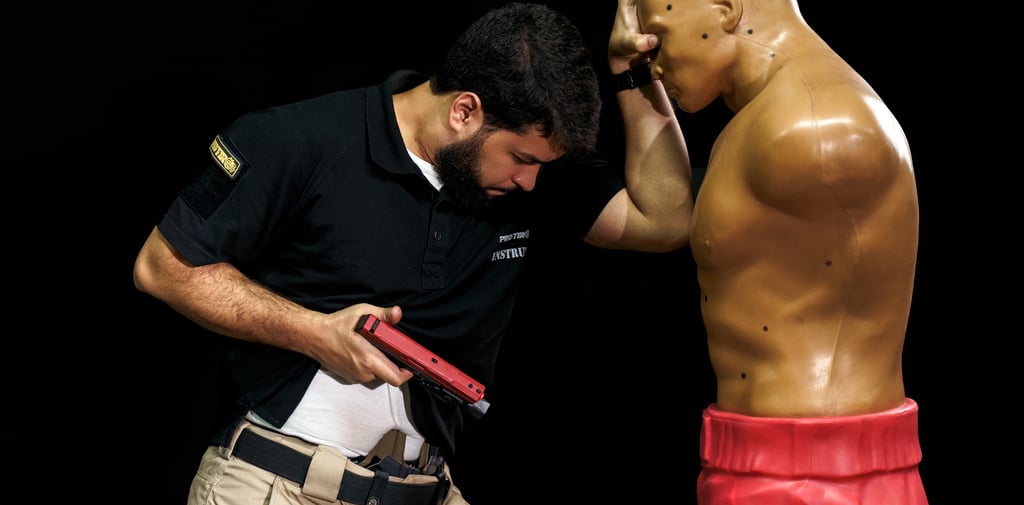
What to do? Short draw. Weapon close to the body. Instead of extending it outward, keep it tight against you, angled slightly downward.
The target? The pelvic region.
Why?
Bigger, less mobile target: The torso moves fast in a fight, but the hips don’t.
Immediate collapse: A fractured pelvis, acetabulum, or femur drops the attacker, preventing pursuit.
Neuromuscular shock: A shot to the pelvis can hit nerves and blood vessels, causing extreme pain and heavy bleeding.
If the first shot doesn’t neutralize, it creates something crucial: space. With the aggressor weakened or off-balance, you gain time to bring the weapon to Position 3 - centered on the chest, muzzle parallel to the ground, firm two-handed grip. From here, your shots are more controlled and precise.
Finally, as you fire, you move to Position 4 - arms extended, sights aligned, full control of the situation.
From instinctive draw to precise fire, every step serves one purpose: to win the fight and go home alive.
Defensive Positions
As you create distance, you may need to block physical attacks - after all, this is a fight for your life. If he throws a punch, being armed won’t matter if you’re knocked out before drawing. Many shooters fail here, focusing too much on the gun and forgetting that you need to stay conscious to even access it. If you’re not conscious, you’re not in the fight.
The solution? Your support arm becomes your shield.
High guard, elbow vertical: Pure defense. Protects your head and prevents a knockout.
Horizontal elbow: Now you’re not just blocking - you’re creating space. With your forearm aligned to the side of your head, you push the aggressor away and prevent him from reaching your gun.
In short: first, stay on your feet. Then draw. If the aggressor is too close, don’t go straight for the gun. Protect yourself, create distance, then react.
Conclusion
When the fight happens at close range, the rules change. You cannot rely solely on a quick draw, nor can you fight as if it were a sporting competition. Striking vulnerable points and using strategic shots are techniques that drastically increase your chances of surviving and going home alive.
Close-range gunfights are extremely dangerous and unpredictable, making it essential, for both law enforcement and armed citizens, to master weapon retention and physical response. Weapon retention training, hand-to-hand skills, and situational awareness are critical for survival, since creating distance and buying time are the best strategies to escape alive.
While the ideal scenario is to prevent the aggressor from ever getting that close to your weapon, you must be prepared if it happens. Self-defense systems like Krav Maga teach targeting sensitive areas (eyes, throat, groin) to interrupt or slow down the assault, creating a window to draw and create distance. In real situations, when there is no time or space to draw, fighting physically may be the only way to guarantee that chance.
Despite the complexity and the body’s natural reactions in high-risk moments, training makes all the difference, even when chance seems to dominate the outcome.
This is a complex topic, full of nuances in both shooting and fighting. What must happen is the breaking of the barrier that separates the two disciplines, bringing them together under one unified perspective. Once and for all, understand this: shooting and fighting are two sides of the same coin. They must coexist. Recognizing this may be the only difference between life and death.
Did you find this article helpful? Let us know, your feedback helps us improve and bring you more relevant content. Send your thoughts to contact@junosolutions.ca