Why Force On Force?
8/28/20253 min read
Bridging the Gap Between the Range and Reality
"How close would an attacker with a knife need to be before you could realistically draw your concealed firearm and stop the threat?"
That’s the question I often use to open my Force-on-Force training module. After six classes of 1:1 instruction, the most common answer students give is surprisingly: “one yard.”
It’s a sobering reminder. On one hand, it means I’m good at building confidence in my students. On the other, it highlights why Force-on-Force (FoF) training is essential: it strips away illusions and confronts shooters with the reality of violent encounters.
From Wooden Swords to Modern Scenarios
Training with non-lethal tools is hardly new. Roman legionaries once drilled with the Rudis, a heavy wooden sword deliberately designed to be more difficult to wield than the real Gladius. The philosophy was simple: make training harder than combat.
Fast forward to the birth of modern policing in the 18th century, and firearms training was still largely static. The focus was accuracy on paper targets, not tactics under pressure. This approach remained the norm well into the mid-20th century.
By the 1970s, U.S. law enforcement began to rethink firearms training. Efforts such as the FBI’s Hogan’s Alley introduced scenario-based exercises, and in the 1990s, the rise of community policing emphasized de-escalation and decision-making beyond simply pulling the trigger.
The Tools of Force-on-Force
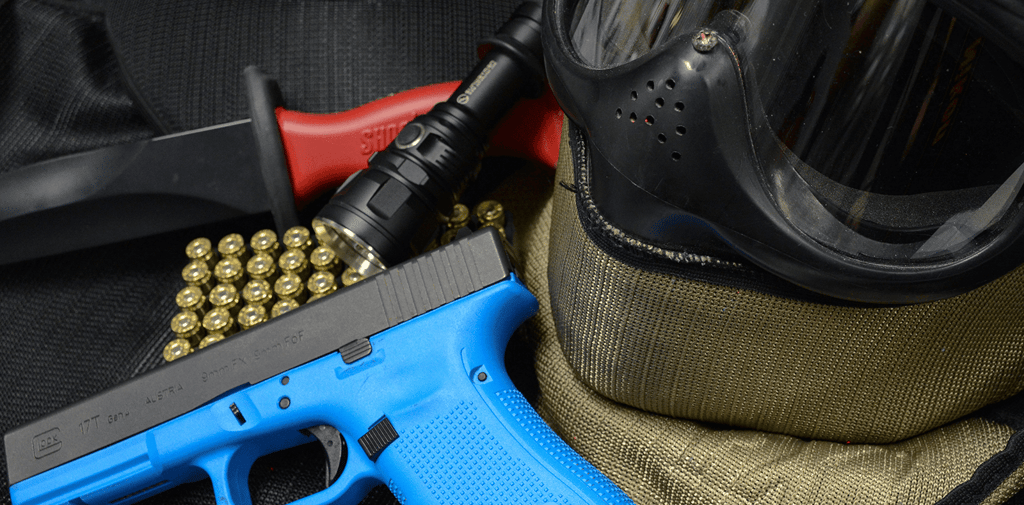
Today, there are dozens of training systems available. Some, like MILES, use laser-based technology to capture data. Others - Simunition, UTM, Paintball, Airsoft, UNIT - offer more tactile feedback, including recoil, malfunctions, ammunition limits, and most importantly: pain.
Pain may sound like a drawback, but it’s vital. Without consequences, training risks turning into a game. A sting from a well-placed round builds caution, realism, and respect for the situation.
Among these tools, Airsoft and the new UNIT platforms stands out as an accessible and cost-effective option. It provides realistic replicas of firearms and is widely available, making it an excellent platform for scenario-based training.
Why Force-on-Force Matters
Live-fire training on paper targets is essential for building fundamentals, but it’s not enough. A range is a controlled environment - a laboratory for mechanics like draw, trigger control, speed and accuracy. Real-world confrontations, however, require more.
Force-on-Force brings in the human element. It creates authentic feedback because the “target” isn’t static - it reacts, moves, and makes decisions of its own.
In the book Force-On-Force Gunfight Training, Gabriel Suarez outlines five core benefits of this approach:
Human Behavior – Only a live opponent can replicate the subtle cues that make split-second shoot/don’t-shoot decisions truly realistic.
Emotional Control – Stress and adrenaline can paralyze even skilled shooters. Properly designed scenarios help students learn to manage fear and pressure.
Multi-Skill Integration – Communication, empty-hand skills, improvised tools, medical aid, and situational awareness all come into play. Shooting is often the least common (and least desirable) outcome.
Safe Mistakes – Students can “fail safely,” review errors with instructors, and reset the scenario - something impossible in real-world encounters.
Reality Check – Stress testing often exposes flaws: snagged draws, poor grip, ignored sights, or gear failures that never appeared on the static range.
Levels of Simulation
Force-on-Force training can scale in complexity:
Duels: The simplest format - one student, one aggressor. This can be expanded with movement, dialogue, low-light conditions, or improvised cover.
Simple Scenarios: Multiple aggressors or role-players in structured situations like a home invasion, a restaurant robbery, or a carjacking.
Complex Scenarios: Full-scale exercises involving teams, vehicles, tactics, and leadership challenges in immersive environments.
It’s Not a Game
This distinction is critical: Force-on-Force is not an Airsoft skirmish. The goal isn't to have fun, it's to learn. Poorly designed scenarios - where students always win - teach nothing and discredit the instructor. A well-designed FoF exercise must include uncertainty, multiple outcomes, and the possibility of failure.
Limitations and Safety
Of course, Airsoft and similar tools are not real firearms. They lack ballistic realism and can create misconceptions about cover, courage, and risk. It falls on instructors to design scenarios that keep training grounded in reality.
Equally important is safety. Treat FoF tools with the same respect as live firearms: mark training weapons clearly, keep real weapons far from the training area, and use proper protective gear. Helmets, eye protection, gloves, padded clothing, and even groin protection are non-negotiable.
Conclusion
Force-on-Force is not a replacement for live-fire training, but it is a critical complement. Think of it like sparring in combat sports: no fighter would step into a professional bout having only hit the heavy bag.
So why should a responsible gun owner rely only on static paper targets to prepare for a lethal encounter? Paper and steel build marksmanship - but Force-on-Force builds survivability.
It is, quite simply, the missing link between the range and reality.
Did you find this article helpful? Let us know, your feedback helps us improve and bring you more relevant content. Send your thoughts to contact@junosolutions.ca